Many, if not most,
religious people go through periods of religious doubt. While there
are those like Rav
Kook and Rabbi
Norman Lamm, who explore the religious value of doubt, doubt can
often be disturbing and demoralizing. What, if anything, can be done
to get through the struggles that come with doubt? I'd like to
discuss an idea that was discussed by Rav Eliezer Berkovits, and
expand upon it.
In the fifth chapter of
his classic work, God, Man and History,
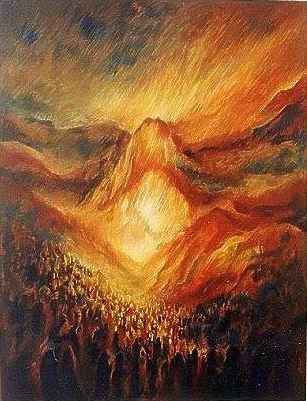
Rav Berkovits discusses the value of the initial religious encounter
with God that occurred at Mount Sinai. Among other things, the
encounter showed that God was a deity who was involved in the world
and cared about his creation, as opposed to the unmoved mover of
Aristotle. He suggests that the encounter serves as a reminder of
God's care, during the many times when He seems absent from our
lives. Just as the thought of her husband, might help an army wife,
when her beloved is away at war, and make up for the silence and fear
that he might not return, the Mount Sinai experience serves as a way
of remembering God's concern, during those painful moments when that
very care is in doubt.
What
of those who were not actually at Mount Sinai? Rav Berkovits suggests
that in the numerous commandments which reference the Sinaitic
revelation, such as the Mishkan, HaKhel and Shavuos, one re-cognizes
(once again thinks of) the revelation, moving it from a moment of
history, to a personal experience.
For
many of us, I'm not so sure that this is enough, and therefore, I'd
like to go beyond Rav Berkowits point. I want to make clear that I am
not suggesting that he would necessarily agree with my idea.
Nonetheless, I think that my extension of his idea is not without
merit.
There
are moments in our lives when we experience God's care and concern. I
can think of several such moments in my own life. While these
experiences are inherently subjective, for those who experience them,
they are real. I would call these moments “Sinai Moments”. While,
unlike the revelation at Sinai, these moments are personal and will
often mean little, if anything, to the one who has not experienced
them, for the one who has, they express God's concern as much as the
moment at Sinai did for those who were there. In this formulation,
these Sinai moments are not merely to be appreciated at the moment
that they occur. Rather, they are to be thought of at those times
that one feels alone and distant from God. In thinking of these
moments, we might experience God's absence as temporary, instead of
doubting his very concern.
Whether
it is through a deeply internalized experience of the Sinai-based
mitzvos, as Rabbi Berkovits suggests, or through thinking of what I
have termed Sinai moments, I would suggest that moments of doubt need
not be experienced passively, hoping that we will once again
experience the breath of the Divine, as it were. Rather, we can
re-cognize moments of care, both big and small, which might help us
get past our moments of doubt, even if only temporarily.