Showing posts with label Charedi. Show all posts

Monday, May 16, 2016

Passionless Judaism- On the differences between the Charedi and MO OTD experience


What more can be said about the OTD phenomenon? So much has been written about it from every perspective, from memoirs to sociological studies to essays examining why Orthodox jews leave the fold. Is there anything left to be said?


I have been thinking about the differences between the many charedim I know who left the fold, versus those from the Modern Orthodox world who left religious observance. Although there are many differences, there is one particular difference I keep seeing. Many, if not most of the charedim I know have a strong emotional feeling about the community they have left, and about religion in general. Quite a few, continue to struggle with, or against, the world they left. Some turn their feelings into organizational work, trying to help others who have left the fold, or those who are still observant. Organizations like Footsteps and Yaffed are just a few examples of this phenomena. Others write about their reasons for leaving, and the mixed emotional feelings they have about the way they grew up. It is not unusual to have OTD Shabbos meals, where zemiros are sung, and traditional foods are on the menu.


By contrast, in the Modern Orthodox world, those who leave seem to leave more quietly, almost as if they have left nothing behind. They rarely continue to be involved in any Jewish organizations, and show little, if any, signs of resentment. To be sure, there are some obvious reasons for these different reactions. While charedim have often been raised in communities where they were not offered the educational, social, and professional skills to make it in the secular world, Modern orthodox jews grow up in a milieu which makes transitioning far easier. Many have gone to the same colleges as their non-religious and non-Jewish peers, and have received an education that makes the switch that much easier. While there might be some degree of resentment about aspects of how they were brought up, for the most part, the people I know from the MO world have left easily, and without much of an emotional struggle. However, there is, I believe, something more behind the different reactions, something that to my mind speaks poorly about the MO educational experience.


I recently read a book that dealt with the philosophical development of some of the founding fathers of the Zionist movement. These leaders had either grown up in religious families, or were one, or at most two generations away from religious ancestors. As each of them struggled to figure out what it meant to be Jewish when one is no longer religious, they struggled mightily with the mixed emotions they felt for the religious world that they knew. They had feelings of pity, nostalgia, and anger. They channeled these emotions into the creativity which led them to be leaders in creating the Zionist movement in terms of political thought, culture, and religion. As I finished reading the book, I couldn’t help but wonder again about the MO people I know who have left without experiencing these same feelings.


For good and for bad, the charedi educational system gets their version of Judaism into their students bones. There is a thick, almost viscous religious, cultural, and emotional sense of what it means to be a frum Jew. When you watch charedi kids daven in school, there is an energy that is generally lacking in MO schools. In charedi yeshivahs, Torah learning is seen as an ideal, and any boy who succeeds in it, is seen as a star. I’ve noticed that even those who are not successful learners, often internalize the message to the degree that, later in life, they financially support yeshivos and kollels. In the MO world, we are not succeeding in giving over this sense of connection. Too often, the davening is not inspiring, and the Torahlearning is seen as, at best, another academic discipline to master. For those who want out, the religiosity they have experienced is easily shed.

Rabbi Lamm once said, talking about Modern Orthodoxy, that our goal should not be “to be moderately passionate, but rather to be passionately moderate”. If we are to be honest with ourselves, we are not only failing at what he suggests our goal should be, but even at instilling a moderate amount of passion. It is beyond time that we figure out how to do better.

Monday, June 1, 2015

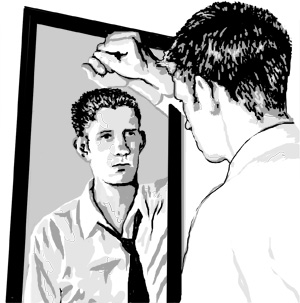
Looking in the Mirror- Some reflections on what I took away from attending a Footsteps event


Since attending the Footsteps event on Thursday evening, I’ve figured out what I want to write...about ten different  times. Each time, I have tried to find a balanced approach that would be honest, free of sappiness, pleasing to friends and critics of Footsteps alike, and thought-provoking. Oh, and also a good read. I’ve decided to write now, not because I’ve found a combination of those things, but because there is a message here that needs to be shared.

Last night, I received a phone call from a Footsteps member I met Thursday night. I don’t know his background story, nor does it matter that much. I do know that he grew up in an insular chassidic community, is now secular, and that he is very involved in Footsteps. He was calling to find out about Project Makom, an organization with which I am involved, that helps charedim who are interested, transition to a more modern Orthodox community. He has a friend who no longer wishes to live as a charedi Jew, and based on a conversation with his friend, he thought Project Makom and not Footsteps would be the right address.

I share this story not because it proves anything about Footsteps, but because it has the potential to show those who think  of Footsteps as “OTD kiruv”, that things are more nuanced than that. If I had to choose the biggest lesson I learned Thursday night, and there were many, it is that Footsteps is not monolithic, and that attempts to paint it as such are unfair and unkind.

As I wrote Thursday night, I’m not going to discuss the private conversations that I had, but in sharing some general ideas, I hope that I can generate some thoughtful discussion, and deeper understanding. After going back and forth several times, I’m not going to try and make use of Jewish sources to justify my views, although I think I could. This is not the place for that.

Let’s start with certain givens. Despite being “frum” and a maamin, I do not believe that, even if presented at its best (whatever that might mean), Torah Judaism (another nebulous phrase) would work for all Jews. Once you factor in communities where religious, educational, and communal decisions are made, for all sorts of reasons, ideal and not, there will always be those who choose to leave. No community, no approach, no amount of strictness, or openness, or anything, will work for everyone. Add in the fact that communities are complex, and often have all sorts of competing pulls, and types of people calling the shots, and, inherently, some people will want out. I do not wish to criticize the charedi world, particularly as an outsider. All I will say at this point is that, as with my community, as with any community, things are not perfect in the charedi world.

Another given. Any attempt by any of us to decide whether someone’s reason for leaving their community, and observance is good or legitimate, is presumptuous. We have no idea what another person has experienced, and even if we did, that would still give us no legitimate reason or right  to judge.

With those givens, let’s proceed. When a person leaves the charedi world, particularly its more extreme manifestations, they need a lot of help to land on their feet. Often, they lack the educational background, as well as the social skills and knowledge of how to interact with those from outside of the world in which they grew up. In addition to needing help with those things, leaving is almost always traumatic. The decision to leave often comes with the regular psychological difficulties that come from leaving one’s world of comfort, as well as the fact that they are often rejected by family and friends. That being the case, there is only one legitimate question that can be asked “How can I help ease your pain?”. Anything else is callous. If that question is asked, with strings attached, it is cruel. A fireman does not ask questions. He just helps those who need to be saved.

Footsteps is an organization that asks this question. It provides help to people so that each member can have the freedom to make the choice they want, and more than anything, freedom seems to be at the top of the list of what its members want. Freedom from limitations on who they can be, what jobs they can have, whom they can marry, freedom of intellectual inquiry, and, yes, for many, freedom from religion. For some, and this is connected to what I just wrote, they also want to be free from a world where they have suffered abuses of all kinds. There are some who are angry, hurt, resentful, cynical and simply anti-religion and dogma.

Watching the program on Thursday night, I heard of people who had been helped to be able to get a GED, go to medical school, and work as a nurse in Haiti helping poor people. I met one man, who, having just gotten his MSW, is working to help children from his former community receive the secular education they deserve. I found myself wondering if there were too many other communities in the world, where these achievements would be met with anything but praise.

I also listened to one speaker talk about the type of religious questions she left behind, and wondered whether a simplistic Torah education which can not even distinguish between peshat and derash, will not lead to people having huge questions, the minute they are exposed to serious areas of thought.

Speaking of which, the internet is a game changer. Gone are the days when the charedi world can, more or less, keep the outside world out. IPhones bring power. A simple Google search can lead to, well, anything. Banning, and threatening probably never was that smart of an approach. Now, it’s also futile.

After the program, I spoke with a friend who had attended a serious Litvish yeshiva. He was never taught anything more than Shas and Rishonim, and his questions were met with answers considered brilliant, only by those who don’t understand that word. Rather than be threatened by the questions, might not we take them as a challenge to step up our game. Shouldn’t we try to  spend serious time thinking about the questions, and how we might respond with honesty and depth when confronted with them?

So what is Footsteps? Is it good or bad? Are they doing OTD Kiruv? What’s their agenda? What are they really like? The simple answer is that there is no one single Footsteps. It is not a person. It is made up of people, many different people. However, if you want to view it in a monolithic manner, I’d say the following. Footsteps is giant mirror being held up to the frum world, challenging us to look at ourselves. Who are we? What’s our agenda? What are we really like? Do we care about each member of our family and community, or only about our reputation, and our team? Before we look past the mirror and ask questions about those who are holding it up, I strongly suggest we look deeply in the mirror, and face ourselves, warts and all.

Monday, May 18, 2015

Place, Show, and Win- Why I'm excited to be part of Project Makom


I’ve been thinking about the reason that I had a panic-dream about a speaking opportunity that is about a month away. I have no problem doing things last minute. Heck, I thrive under that pressure. Back in  my college days, I was able to write a paper and complete a project two hours before they were due (I got a B on each, thank you very much). I love public speaking, and, on the rare occasions when I’ve had panic dreams, they’ve come the night before, rather than many weeks in advance. So why am I a little nervous about my opportunity to speak at the Project Makom shabbaton?

As soon as I heard about Project Makom, I volunteered. Having heard about, and witnessed the serious challenges involved in moving from one’s religious community, I was excited about the opportunity to be part of an organization that makes such a transition easier. Regardless of the destination of the person who chooses to leave the charedi community in which they grew up, it seems obvious to me that, we, both as individuals and as a community, should want them to land on their feet. As such, and I hope this is not too shocking, in some ways I see Project Makom and Footsteps as being two sides of the same coin, in that we both want to help former charedim transition to a healthy and productive life.

Which brings me back to my speech. What is it that I would like to say? Most obviously, while the people involved in Project Makom are, more or less, Modern-Orthodox (I wish we could move past labels), it is important that we recognize that we have much to gain, and not just give, by welcoming former charedim into our community. While there is much that is positive in the MO world, like all communities, it is far from perfect. To cite just one example of many, I have many times been moved by the warmth and passion that I have found when davening, or having shalosh seudos with various chassidic communities. It is my hope that by welcoming more people who come from chassidic communities into our community, that our davening and zemiros will get a much needed boost.

It is in thinking about the gains that both sides will make, that I start to get a slightly mischievous thought in my mind. Perhaps what we are really doing at Project Makom is not welcoming former chassidim into the Modern Orthodox world. Perhaps we are really all just joining together and going back to the roots of the chassidic world. A world where there is little need for hierarchy. A world where “B’chol drechecha da’eihu” is truly a guiding principal. A world where Jews of all types and stripes can learn, sing, and speak together. If that is what we are able to do, I am hopeful that HaShem, who is the true Makom, will bless Project Makom with success.

Thursday, May 22, 2014

Accepting the Other- The Precursor to Unity


Before my trip to Israel in March, I spoke a lot about Achdus/t, unity. Seeing a fractured Jewish world, my initial response was that unity was the answer. While I still very much believe in Achdus, and continue to try to work with individuals who share this view, on a communal level, I no longer believe that achdus is currently achievable between the Modern Orthodox and Charedi worlds. Instead, I'd like to pivot and suggest a new communal goal, which might be a step towards ultimate unity.

When one speaks of unity, it is between people who see themselves as part of the same group. The more homogeneous, and the smaller the group, the easier it is to have unity. As the group becomes more heterogeneous, and larger, it is harder to keep everyone together. Over time, this usually leads to infighting, and ultimately, a split.

Comedian Emo Phillips has a great routine that highlights this point. He tells of an encounter with a man who is about to jump off of the Golden Gate Bridge. In trying to talk him down, Phillips starts to discuss religion. He asks the man whether he is Christian or Jewish. The man answers Christian. Emo responds “Me too”. He continues by asking Catholic or Protestant, and when told the latter, he once again responds “Me too”. The questions continue, with the same response of “Me too”, until, upon discovering that they are members of slightly different sects, Phillips says “Die Heathen!” and pushes him off the bridge.

Unity involves more than being part of the same people. No one, on either side of the divide, denies the Jewishness of the other. Where communal unity becomes impossible is when we turn to theology and halacha. The modern Orthodox (and for the point of this post, I'll be a little less nuanced, and include the dati leumi community under that title) and charedi worlds, have too many differences over what we believe God asks of us, relating to the outside world, the State of Israel, secular Jews, non-Jews and more. Regardless of who is correct, or even whether many of these issues have a single “right” answer, there is too much that divides us. The differences are so strong that we are unable to agree to disagree. I do not wish to deal with whose fault it is. Let's leave it that each group too often seeks to demonize the other. Let's ignore the question of fault or blame.

So, what is the alternative? Is there a way to move from the status quo? I believe there is. One, is less than ideal, but might just be the best that we can hope for. The other is far more ideal, and far harder to achieve.

In the Kuzari, Rabbi Yehuda HaLevi tells the fictional story of a king who has a dream, where God informs him that he is on the wrong path. The words that God says are instructive. “Your intentions are good. Your actions are not good”. God acknowledges that the king means well. He is trying to do what is right. The problem is that he has chosen the wrong path. The king has good and noble goals, he's simply not doing the right things to achieve them. It is one thing for God to say this. After all, He knows that which is objectively. When a person uses these words, there is a bit on condescension in them. “Now, now” he says, sounding a bit like a scolding parent or school marm. “I know that you meant well, but let me tell you how it's done”. It is this connotation that makes it less than ideal. Implicit in the message is that we are right and you are not.

The second possibility is to recognize that our “objective” knowledge is, with few (possible) exceptions, subjective. Everything that each of us sees, we see through our own eyes, and understand through our own minds and biases. With this perspective, we can recognize that the person who sees things differently can have the same goal, but think the way to achieve it is different (Of course, we can and should extend this to people with other goals). Here, the goal is not agreement, or necessarily interaction. The goal is simply to understand that the other group is not anti-Torah or anti-God. It is much more difficult to achieve because we often fail to recognize that we are inherently subjective.

This new goal is much less noble sounding than a call for unity. It is however a necessary precursor to unity within our community. Before we can love our fellow like ourselves, we first need to stop demonizing him. This is the longer shorter way.