Showing posts with label second chances. Show all posts

Tuesday, March 10, 2015

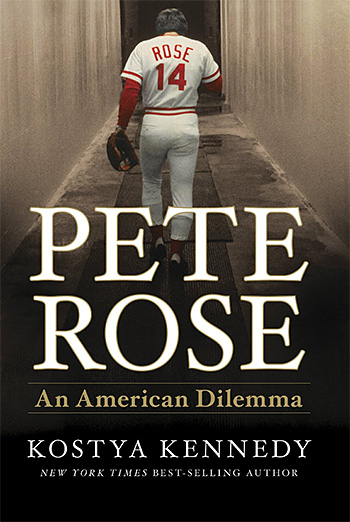
Prisoner with No Bars- A review of "Pete Rose- An American Dilemma" by Kostya Kennedy


What if your greatest strengths were also your greatest flaws? What if the very traits that made you great, and famous and loved, were the same ones that led to your biggest failures and caused people to dislike, or, maybe even worse, pity you? How about if you only knew one approach to life, one that made you a hero in one part of life, and a failure in so many others?


As a baseball fan, for as long as I can remember, and an avid reader for a little less than that, I’ve read more than my fair share of baseball books. The ones I’ve always enjoyed the most are the ones that, while outwardly about baseball, are really about life. “Pete Rose: An American Dilemma” by Kostya Kennedy fits the bill, and is one of the best baseball books I have ever read. Of course, it is much more than just a book about baseball. It is a book about a very flawed man, whose one-size-fits-all approach to life, leads to a story that reads like a Greek tragedy. Kennedy, who many sports fans will recognize from his writing for Sports Illustrated, tells the story masterfully, showing who Rose was and is, on and off the field, and who he seems destined to be until the day he dies.


Pete Rose, who early in his career was dubbed “Charlie Hustle”, played the game the way it was meant to be played. In a sport where even the greatest players take it easy at times, Rose played every game, exhibition or regular season, as if it was his last, and as if he was still trying to prove himself to his father. This single-mindedness made him a star, but also led to his being a poor husband, father, and sibling. It was as if the only way he could live was by ignoring everyone else’s needs. Ultimately, it led to his banishment from the game of baseball and the hall of fame, for gambling on baseball.


Kennedy tells Rose’s story and shows how those who loved him, including his two ex-wives, children and siblings, and those who rooted for him, ignored or even embraced his biggest flaws, as part of the Faustian deal of being part of his life. Given this tolerance for his flaws, along with the help he received in protecting him from the consequences of most of his decisions, one could almost say that Rose never had a chance at coming clean and taking responsibility, after his gambling addiction led to his banishment from the game he loved. Even when confronted with thousands of pages of evidence, Rose remained defiant, convinced that he could talk his way out of this problem as well. Kennedy powerfully shows how the people involved in the investigation, including the literally larger than life lawyer John Dowd, and commissioners Bart Giamatti and Fay Vincent, stood up to Rose and his handlers, showing him and them that, for one of the few times in his life, he would have to pay the price for his actions.


By the time one reaches the later part of the book, he knows that Rose will fail to take advantage of the opportunity to learn from his mistakes. By this point, the reader will be familiar with the many missed opportunities for Rose to right his life, and even wonder whether he wants to. While Kennedy poignantly shows a few too brief moments where a more introspective Rose appears to recognize what he has wrought, he also shows that for Rose, there can be no second chances, in a life lived with lots of hustle, but no brakes.

Americans will give a second chance to almost anyone, provided that they are willing to apologize sincerely or not. Most of the time, a publicly issued mea culpa will make up for almost any sin. Kennedy notes the irony that a man as real as Pete Rose, a man who can not be anyone other than the man he is, no matter the circumstances and consequences, has never been able to offer even a somewhat convincing admission of guilt for what he has done. More than that, Kennedy shows that the very approach that led to Rose being one of the greatest players in baseball history, is the same approach that has cost him so dearly. In the end, it is hard for the reader to muster much sympathy for a man who seems incapable of looking at himself in the mirror, a man who still doesn’t realize that he is is own worst enemy.

Wednesday, March 4, 2015

Second Chances- How the Jews of Shushan came to re-accept the Torah


In what is one of my favorite midrashim, Chazal suggest that Bnei Yisrael’s initial acceptance of the Torah, in the time of the Exodus was flawed, and was only corrected in the time of Purim. I’ve always been fascinated by the imagery and idea of God holding a mountain over the heads of Bnei Yisrael and forcing them to accept the Torah, as well as the recognition that this type of acceptance was inherently flawed. What could this mean, and how can we suggest that the Torah was re-accepted in the time of the Purim story, at the time when the Jew’s lives were literally threatened.? I’d like to suggest that the answer might be found in a poem.


In Renascence, a poem written by Edna St. Vincent Millay nearly 100 years ago, the story is told of a person who discovers  the grandeur of the world in which she lives:

I screamed, and—lo!—Infinity

Came down and settled over me;
       
Forced back my scream into my chest,

Bent back my arm upon my breast,

And, pressing of the Undefined

The definition on my mind,

Held up before my eyes a glass
       
Through which my shrinking sight did pass

Until it seemed I must behold

Immensity made manifold


Later, she discovers that extant within that grandeur, there also exists a world of pain and suffering

A man was starving in Capri;

He moved his eyes and looked at me;
       
I felt his gaze, I heard his moan,

And knew his hunger as my own.

I saw at sea a great fog bank

Between two ships that struck and sank;

A thousand screams the heavens smote


Unable to see and, even more, feel and bare the pain, she asks to die and is given her wish, and thus, freed from her pain

Long had I lain thus, craving death,

When quietly the earth beneath

Gave way, and inch by inch, so great

At last had grown the crushing weight,

Into the earth I sank till I
       
Full six feet under ground did lie,

And sank no more,—there is no weight

Can follow here, however great.

From off my breast I felt it roll,

And as it went my tortured soul
       
Burst forth and fled in such a gust


It is only when she hears the rain fall upon her grave that she comes to realize that she will never again witness the beauty and grandeur of the world

I would I were alive again

To kiss the fingers of the rain,
       
To drink into my eyes the shine

Of every slanting silver line,

To catch the freshened, fragrant breeze

From drenched and dripping apple-trees.

For soon the shower will be done,
       
And then the broad face of the sun

Will laugh above the rain-soaked earth

Until the world with answering mirth

Shakes joyously, and each round drop

Rolls, twinkling, from its grass-blade top


She prays and is given back her soul, and with it, a second lease on life

Ah! Up then from the ground sprang I

And hailed the earth with such a cry

As is not heard save from a man

Who has been dead, and lives again.

About the trees my arms I wound;
       
Like one gone mad I hugged the ground


Given a second chance, she discovers the Godliness that has existed in the world all along, ready to be seen by those who will only open their eyes

The world stands out on either side

No wider than the heart is wide;

Above the world is stretched the sky,—
       
No higher than the soul is high.

The heart can push the sea and land

Farther away on either hand;

The soul can split the sky in two,

And let the face of God shine through.
       
But East and West will pinch the heart

That can not keep them pushed apart;

And he whose soul is flat—the sky

Will cave in on him by and by.


Let’s apply this to the aforementioned midrash.


When Bnei Yisrael received the Torah, they existed in a bubble where God’s grandeur could not be ignored. They owed their very existence to God’s miracles, and could not have survived in the wilderness without them. Awestruck, they had no choice but to accept the Torah. Still, such an agreement is inherently lacking. How can an acceptance based on an unworldly experience count, for those who would soon be thrust into a world of pain? Would they not have tremendous remorse when they discover all of the suffering that exists within the natural world? One could certainly argue that their acceptance was based upon a faulty understanding.


The Jews who lived at the time of the Purim story, were living in a very different world. Their world was one where 10 of the of the 12 tribes had been driven off, perhaps, to never return again. Theirs was a world where God’s very existence seemed to be open to doubt, as He had allowed thousands of men, women and children to die, and allowed His holy abode to be destroyed. One could not blame the Jews of that generation for wishing to give up; to metaphysically die, and stop having to deal with the struggles of theodicy.

Then, they are given their wish. They are told that the chosen nation will no longer have to live with the struggles, or, in fact, live at all. A genocidal maniac is ready to destroy them all. On the cusp of destruction, after coming together and praying, they are given a second chance. This time, they accept their relationship based not upon miracles, but upon a realization that, even when He appears absent, that God can be seen by those are willing to look.