Showing posts with label mysticism. Show all posts

Sunday, August 17, 2014

Tzamah Nafshi- A second attempt at articulating my thoughts on mysticism for moderns


One could, if he so desired, break down the idea of love, to a combination of biological and physiological urge. Mix in some psychology and some evolutionary development, and love could be stripped of all of its romantic tendencies and notions. Thankfully, for those of us who are romantics, such reductionist thinking would be correctly understood to be missing the forest for the trees. I would contend that Modern Orthodoxy, in emphasizing rationalist approaches to Judaism, to the exclusion of mystical approaches, has made the same reductionist mistake.

Allow me to begin by making one thing clear. I do not believe in the metaphysical or theurgical claims of Kabbalah. I do not learn Torah to create heavenly worlds, and I do not see myself as a puppet whose strings can manipulate the Puppeteer. Still, I have come to believe that in rejecting the factual claims of mystical thought, Modern Orthodoxy has gone to far and thrown out the creative and passionate language of Jewish mystical thought.

Rambam describes the mitzvah of Ahavas HaShem as being analogous to a man who is in love with a woman and can’t keep her out of his mind. Echoing the words of Dovid HaMelech, he says that a person reaches the level of “taavah”- desire, to know HaShem. Even parts of the Moreh Nevuchim have language that can be called mystical, and Rambam’s son, Rav Avraham, certainly went in that direction.

Professor Shalom Rosenberg has gone so far as to suggest that the difference between rational and mystical notions of Ahavas Hashem, as being analogous to the difference between romantic and erotic love. While the latter term may seem, to some, to be out of place, in a religious discussion, the desire for ultimate closeness to God may be experienced and felt  through the singing of Lecha Dodi, Yedid Nefesh, or Tzamah Nafshi, the latter of which was written by Ibn Ezra (!).

I would suggest that, living in a post-modern era, the recognition that we can never objectively know Truth (with a capital T) frees us us up to use language that talks of God in ways to which we can better relate. Rav Solovitchik once noted, after it was made clear to him that his talmidim did not want to hear shiurim from him on Tanya, that his students only wanted his brain, as opposed to his soul. Since that time, for most of the Modern Orthodox world, things have moved even more in the overly-rational direction. One does not have to look to Kabbalah to find mystical language within our tradition as it can be found in parts of Tanach, and within some words of Chazal. To the degree that we keep such ideas and language out of the classroom, we cheat our students out of a possible way to engage passionately with God and his Torah.

Although much of Modern Orthodox thought speaks to me, too often I find it expressed in overly clinical ways, devoid of passion. By ignoring the mystical language that can be found in Tanach, Chazal, Rishonim and some of the greatest and most creative modern Jewish thinkers such as Rav Tzadok, Rav Kook and Rav Hutner, we run the risk of making Torah and mitzvot into a scientific and dispassionate pursuit. We have already seen the costs of such an approach, and it is time to turn things around before more damage is done.

Monday, July 28, 2014

Mysticism for Moderns- Lessons learned from three days in Tzfat


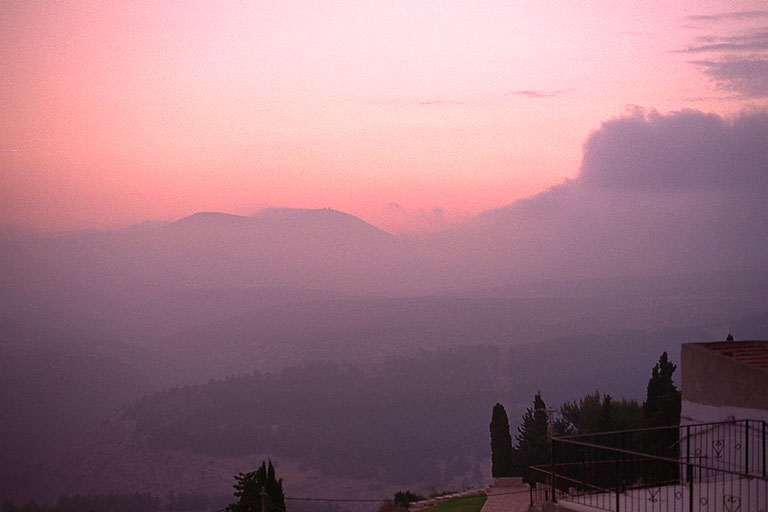
You don’t have to study the Zohar to be moved by the orange-purple glow of the sun setting over the mountains surrounding Tzfat during Kabbalos Shabbos. Looking out the window of the Breslov shul, it is easy to imagine Rav Shlomo Alkabetz writing the kabbalistic words of the Lecha Dodi. The wispy clouds hanging over the mountains add to the moment. I feel an almost tangible closeness to God as I sing the words to the last stanza, "Bo'i b'shalom".

What am I to make of this? I have studied very little of the Zohar, and I am quite uncomfortable, to say the least, with many of the ARI's practices, and about visiting kevarim. I am a card carrying Modern-Orthodox Jew, for whom philosophy and logic often trumps feeling. Still, there is a certain sterility to the language of philosophy and rational approaches to religion. When God is reduced to an idea, it is hard to feel God's embrace, or to passionately engage in mitzvos like tefillah. For those of us, like myself, who seek an emotional component within our observance, and, at the same time, reject many if not all of the claims of kabbalah, what is there to do?

Too often, mysticism is confused with kabbalah, when in reality, they are not inherently connected. One can study the Zohar in a purely rational manner, and it is possible to have a mystical experience without any understanding of Sefiros and klippos. During my time in Tzfat, I felt God's presence through nature, music, the cobblestone paved streets, and the glow of a Breslover's face, as he discussed his journey from Gush to the world of Rav Nachman.

I am often moved by the insight of chassidic masters like Rav Tzadok, and Rav Nachman, even as I am unable to accept many of the concepts and claims that serve as the backdrop of their ideas. I love the experience of hisbodedus, talking to God while out in nature, even as I wonder about its efficacy.

I would contend that Modern-Orthodoxy would benefit from an infusion of mystical language, and a tolerance for experiences that allow us to feel, rather than just think. To be sure, there will be those who have no need for any experience that is anything but cerebral, but years of teaching tells me that they are in the minority. It is time to move past the conceit of thinking that everything can be grasped by the intellect and that being modern means you can't also be a little mystical.

Monday, June 9, 2014

Does Modern Orthodoxy Have a Future?


In the Middle Ages two theoretical approaches to Jewish thought emerged; rational philosophy and mysticism. Although neither approach was completely new, they were “new” in the sense that they were formulated in a way that made them accessible to the average Jew (or at least, the average Jewish male). By the 14th century the two were vying for the minds and hearts of Jews across Europe. Many of the greatest and most well-known Rishonim could be found in one of the two camps. It was far from clear which approach, if any, would win the day.

Looking back from where we sit today, it's hard to imagine that the two approaches were ever on equal footing. In terms of popularity, mysticism seems to routed rational philosophy. The chassidic world, and large parts of the Sefardic and yeshivish communities follow approaches which lean heavily, if not entirely, on mystical thought. Meanwhile, books like the Moreh Nevuchim, Sefer HaIkarim, and Ohr HaShem are for the most part, absent from the yeshivah curriculum. Even Rambam's Yud Gimmel Ikkarim, survives today absent the philosophical ideas which lay behind their formulation. While some of the popularity of mystical thought can be explained by the major tragedies which occurred in our community over the past 600 years, as well as personalities like the Baal Shem Tov, the Baal HaTanya and Rav Chaim Volozhin, there seems to be something else at play. Mysticism seems to tap into some human need, in a way that rational philosophy does not. It invests halacha and tefilla with a level of significance that is not found in the rational approaches. Mysticism suggests that our actions matter in the most serious of ways. In communities where mysticism plays a significant role, there is a high level of commitment, and, often, passion.

What does this mean for those of us who are not moved by and/or can not accept the claims made by mysticism? Is there a way to create communities where Avodas HaShem is not only important, but is engaged with in a serious and passionate manner? I'm not so sure. Rabbi Norman Lamm once said that our communities should be passionately moderate and not moderately passionate. If this is indeed the goal, for the most part, we are failing. A rabbi I know once shared a story with me. He told over the story of Franz Rosenzweig in his shul. Rosenzweig, who became a serious Jewish thinker, had been ready to convert to Christianity. Shortly before his conversion, he attended a Kol Nidrei service in a Chassidic shtiebel. Rosenzweig was so moved by the experience that he decided not to to convert. The rabbi asked his congregation “If Rosenzweig had davened with us, would he have stayed Jewish”?

While, to some degree, I think the problem is worse for the Modern Orthodox communities in the diaspora, which often lose their most inspired members to aliyah, it is an issue in Israeli communities as well. A friend of mine, who lives in a community which is built near a well-respected Hesder yeshiva, bemoaned the fact that many of the teenagers of the community were less “into it” than their parents. I would also suggest that the draw of Carlebach, both in terms of music and davening, as well as other neo-Chassidic approaches suggest that the youth from moderate communities in Israel are looking for something “deeper”.

To be sure, truth is not a popularity contest, but it is time for those of us in the Modern Orthodox world to wake up and figure out what we can do to create more meaningful religious experiences for us and our children. If our approach is not able to better engage our hearts and souls, it will not matter how much it engages our minds.


Monday, June 2, 2014

Proceed with Care- Deconstructing Judaism


Someone once asked Rav Shlomo Zalman Auerbach zt”l the following question; If I stay up on Leil Shavuos to learn, I will be exhausted for the entire chag and it will prevent me from learning properly. Is it better for me to go to sleep as usual rather than stay awake?

How might you have answered the question? Perhaps, if you were into being totally rational and historical you could have said as follows. The 'custom” of staying awake on Leil Shavuos is only about 500 years old. None of the Rishonim practiced it. It's not found in the gemara. The story that lead to it, involving the Ari and Rav Yosef Karo is hard to understand and believe. Thus, if you will lose more learning than you will gain, go to sleep as usual. Rav Shlomo Zalman answered differently. He told the man that this is an important custom and that he should learn for part of the night before going to sleep. I'm not interested in analyzing his answer as much as I'm interested in thinking about what we can take away from it and why our initial answer was wrong, even while it is factually correct.

In the movie “Big Fish” we are told the story of Will Bloom, a son who is estranged from his father. For years, his father Edward has told stories, most of which are, at best, hard to believe, and are probably completely false. As his father lays dying, Will comes to visit him in the hospital. Here too, Edward tells more stories, none of which are any more believable than any of the others he has told. Will plays along, even going so far to finish off the story, as his father becomes to weak to finish. As he finishes the story, his father breathes his last breath. At Edward's funeral, Will meets a number of his father's friends. While he indeed learns that some of the stories were, at least exaggerations, he discovers that there was truth behind many of them, and that even the ones which were purely fictional, were not lies.

As I learned more Torah, I discovered that there is no obligation to kiss the mezzuzah, or a sefer that falls. I found out that Rebbe Shimon Bar Yochai did not write the Zohar or die on Lag BaOmer. In short I cam to a more halachically valid and historically true approach to Judaism. What I discovered was that not only did this not make my observance more meaningful, it brought out the worst in me. I judged others for practicing a form of Judaism that was inferior to mine. I also discovered that the more I removed from Judaism, the less I was moved by Judaism. Then I came upon biblical criticism and modern scholarship and came to recognize that my “better” version of Judaism had detractors as well. Detractors who could also dissect it, and show how imperfect it is.


I am not suggesting ignorance, where we put our fingers in our ears, and close our eyes to not hear that which makes us uncomfortable. I am suggesting that we dissect, discard and demolish with extreme care. If we do not, we risk destroying the very thing we seek to save.