Monday, July 28, 2014

Mysticism for Moderns- Lessons learned from three days in Tzfat


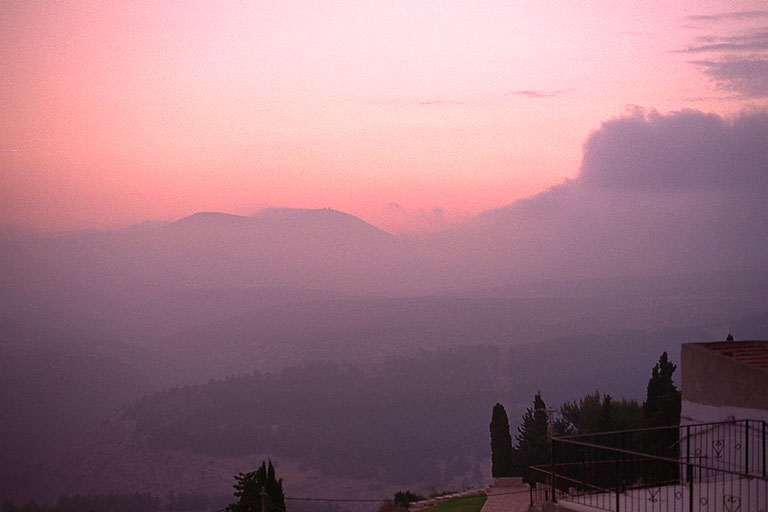
You don’t have to study the Zohar to be moved by the orange-purple glow of the sun setting over the mountains surrounding Tzfat during Kabbalos Shabbos. Looking out the window of the Breslov shul, it is easy to imagine Rav Shlomo Alkabetz writing the kabbalistic words of the Lecha Dodi. The wispy clouds hanging over the mountains add to the moment. I feel an almost tangible closeness to God as I sing the words to the last stanza, "Bo'i b'shalom".

What am I to make of this? I have studied very little of the Zohar, and I am quite uncomfortable, to say the least, with many of the ARI's practices, and about visiting kevarim. I am a card carrying Modern-Orthodox Jew, for whom philosophy and logic often trumps feeling. Still, there is a certain sterility to the language of philosophy and rational approaches to religion. When God is reduced to an idea, it is hard to feel God's embrace, or to passionately engage in mitzvos like tefillah. For those of us, like myself, who seek an emotional component within our observance, and, at the same time, reject many if not all of the claims of kabbalah, what is there to do?

Too often, mysticism is confused with kabbalah, when in reality, they are not inherently connected. One can study the Zohar in a purely rational manner, and it is possible to have a mystical experience without any understanding of Sefiros and klippos. During my time in Tzfat, I felt God's presence through nature, music, the cobblestone paved streets, and the glow of a Breslover's face, as he discussed his journey from Gush to the world of Rav Nachman.

I am often moved by the insight of chassidic masters like Rav Tzadok, and Rav Nachman, even as I am unable to accept many of the concepts and claims that serve as the backdrop of their ideas. I love the experience of hisbodedus, talking to God while out in nature, even as I wonder about its efficacy.

I would contend that Modern-Orthodoxy would benefit from an infusion of mystical language, and a tolerance for experiences that allow us to feel, rather than just think. To be sure, there will be those who have no need for any experience that is anything but cerebral, but years of teaching tells me that they are in the minority. It is time to move past the conceit of thinking that everything can be grasped by the intellect and that being modern means you can't also be a little mystical.

Saturday, July 26, 2014

The Return of the Music


The first time I  felt an emotional connection to Judaism, at least that I remember, was through music. Kabbalas Shabbos and Seudah Shelisheet at Moshava, moved me at a time when nothing else Jewish did. During the year, I longingly looked forward to the first Shabbos of camp. The songs we sang still move me in a way that I can’t explain.

When I was 14 years old, we spent the summer in Israel. Saturday nights were the time to go up to Har Tzion, to a cave where we would listen to the Diaspora Yeshiva Band. I don’t remember the music, but I do remember how happy my father ob”m was each time.

I wake up. I’m in my bed. I hear my father whistling a Jewish tune as he prepares breakfast for my siblings and I.

When Rochie and I were dating, my parents got us tickets to hear Diaspora. Afterwards, Rochie wrote my parents a thank-you note. I don’t remember what it said. Only that it was filled with love and kindness

Rochie and I accidently discovered Zusha’s, probably the only mehadrin bar and grill in the world, and Chaim Dovid, who played there every Thursday night, by accident. His music touched us deeply, and I feel a touch of sadness each time I pass the empty lot where Zusha’s used to be.

The year my father died was the worst year of my life. I took the laws and customs of morning very seriously. I listened to no music the entire year. By the end of the year, I was 100 pounds overweight.

I am at a Moshav concert with a friend. People get up to dance. I try to join, but I just can’t let myself go. I’m too scared of what people might think.

While this summer has been amazing in so many ways, it’s been very intense and filled with sadness. With the kidnappings, two funerals and a shiva, and of course the war, I have shed more tears than at any time since I was a baby. By the time we arrived in Tzefat on Thursday night, I was on empty. Late that night I went across the street to the Ascent Center, where the most soulful music was being played on two violins, a banjo and a bongo, accompanied by the singing of a dear friend, in a cave-like room with an arched ceiling. There was no light other than whatever a few flickering candles could provide. I took it in as if it was oxygen. At one point, I stood up. I wasn’t dancing as much as I was moving gently to the music, as if I was one of the flames. The fear I once had was gone. All the sadness and tension poured out of me. The music had returned.

Wednesday, July 23, 2014

Tears and Hope- Thoughts from Max Steinberg's Funeral


I lack the words to tie these moments together. Three times I have started writing, and three times I have failed to convey what I am feeling. As this has never happened before, I will simply present a few snippets from the funeral of Max Steinberg ZTvK’L.

We are part of a huge crowd as we approach Har Herzl. I can only compare it to walking towards a stadium for a sporting event, only there is much less energy, and a palbable silence. 30,000 people have put their lives on hold, to mourn a young man they have never met. He was a chayal bodeid, but the crowd makes it clear that he was never alone.

As we enter Har Herzl, there is a woman handing out papers to each of us. I expect it to contain some Pirkei Tehillim, or a list of those who will eulogize Max. When I read it, I discover that it is instructions for what to do if the Tzeva Adom siren goes off.

As it is announced that kaddish will be recited, I glance over at the man standing next to me, who is bare-headed, wondering what he will do. He answers along to kaddish. After all I’ve witnessed this summer, I am only surprised that I am surprised.

Max’s father who, along with his wife, is in Israel for the first time, ends his eulogy with the words “Am Yisrael Chai”. I weep uncontrollably.

It is clear from his brother, sister and friends, that Max was a big Bob Marley fan. There were many Marley quotes. My favorite was “Live for yourself, and you will live in vain. Live for others, and you will live again”.

A friend eulogizes him and says “When I would say goodbye to him, I’d say ‘I love you, bro’ in English’ and he’d say ‘Ani oheiv otecha, achi’, and we’d hug. Max, I love you, bro. Ani oheive otecha, achi. Sending you hugs”.
Dov Lipman manages to add a slightly more religious angle in a very sensitive and soft-stated way. He even throws in his own Bob Marley quote. He speaks from the heart and with a great deal of sensitivity. He gets what it is to be a rabbi. He really gets it.

There is a degree of professionalism in the way the funeral is run. I am saddened as I realize that this is due to way too much practice.

Near Max’s grave, there are new graves for an Ethiopian, a Russian, and a Frenchman. This is not the kibbutz galuyos for which we yearned all these years.

The funeral ends with the HaTikvah. Today it sounds both haunting and defiant.

As we slowly walk past the kever, an announcement asks us to leave to prepare for the next funeral. Absolutely heartbreaking.

I am touched to get to say a few words of comfort to Max’s parents. Although I am trying to comfort him, Mr. Steinberg’s warmth and hug comfort me.

I am so proud of Meir, who only weeks earlier sat silently with his campmates, unsure of what to say to the Fraenkels, as I see him offer words of kindness to Max’s father. This is not the type of chinuch I want to give my son, but I am proud to be his father.


Tuesday, July 22, 2014

Now Is the Time- Stand with Israel IN Israel


I’m not brave. I hate the sight of blood. I lock my car door when I drive through dangerous neighborhoods. I write these words of introduction so that you understand the words that follow do not come from someone with real or fake bravado.

The United States State Department has issued a an advisory against travelling to Israel. I don’t know the protocols that lead to these advisories, but I do know the facts on the ground. I have spent more than three weeks as the head counselor for Camp Sdei Chemed, a touring program for Anglo teens. We have travelled from the north to south, and from east to west. I am using my laptop a short drive away from Eilat. We are careful and risk averse. We have more than 40 young men (there is also a separate girl’s program) whose safety is in our hands, and we take that very seriously. At the same time, we are here to experience Israel. To give our boys a love for this great land, and the chance to see it in an organic and real way. We have been to the Fraenkel shiva house, put on a free carnival for children who were scared of the sirens, visited hospitals to sing and play music for the patients, and prepared packages for soldiers and people in the south. We have also gone on stunning hikes, interacted with the locals, gone biking around the Kinneret, scuba diving in Eilat and more. I have heard a grand total of three sirens in my time here, and at no moment have I felt that I was in danger.

I’ve spent more than three years of my life in this wonderful country and here’s the thing. I’ve never felt happier to be here. My presence tells my friends and their fellow citizens that they are not alone. That Americans don’t just come here when it is easy. Being here at this time has increased my desire to live here once again. The achdus I have witnessed, the joy I have experienced watching our campers dance with Israeli soldiers at the kotel, and the strong, proud resolve I have witnessed from Israel’s citizens, reminds me how much I belong here.

I know that Israelis appreciate the rallies that are taking place throughout the world in support of the Jewish State, particularly when there are so many hate filled-rallies going on at the same time. Still, what they really want, what they really deserve is to see as many people here as possible. To see how much support they have throughout the world. Now is the time to visit, to book plane tickets for Succos, to make sure that your next vacation is here. If you are worried about travelling to dangerous areas, I’d advise you to stay out of Chicago. I hear it’s a war-zone over there.

Saturday, July 19, 2014

Yamim Ba'im- Kabbalat Shabbat at Jerusalem's First Station


While according to Jewish tradition Eliyahu HaNavi will announce the arrival of the Moshiach, who will announce the arrival of Elyahu HaNavi? I think I saw some worthy candidates this past Friday afternoon.


In the 16th Century, Kabbalos Shabbos was introduced in Tzefat by the kabbalists. While today, Kabbolas Shabbos has become a formal part of the Friday night service, it started out quite differently. Combining eight perakim of tehillim with the kabbalistic “Lecha Dodi”, it was originally sung before Shabbos, accompanied by music. The rabbis from Tzefat modeled this on the talmudic idea of going out to the field to welcome the Shabbos queen.


In the last decade, there has been a Jewish renaissance  among secular Israelis. While this interest is expressed through Jewish learning and practice, it is decidedly not halachic. In cities around Israel, Kabbalat Shabbat has taken root among the chiloni community. Intrigued by this idea, I went to see and experience the communal Kabbalat Shabbat in Jerusalem.


As I entered the Old Central Train Station, which has been transformed into an upscale outdoor mall and open space, I saw approximately 200 people sitting on plastic chairs. The crowd included men and women, young and old, religious and secular. Men with velvet black kippot stood waiting near women wearing shorts and t-shirts. Couples dressed in a way that identified them as coming from the national-religious camp, mixed easily with their secular counterparts. The band, which was made up of four men and one woman, seemed to be a mix of religious and secular musicians.

Then, the most soulful Yedid Nefesh I have ever heard, began. It wasn’t just the musical accompaniment that moved me so deeply. It was the setting, the people, and the sun beginning its descent over Jerusalem, as well as a sense that something magical was happening here. I closed my eyes, swayed to the music, and sang along un-self-consciously. It was followed by a devar Torah by a bare-headed man, and a moving Carlebach-y “Lechu Neranena”.


I found myself thinking about what I was observing. For the halachicly fastidious, there was much to critique. Still, it seemed to me that to use such a prosaic calculus was to miss the unique experience that I was missing. People from groups that don’t commonly interact, together sang the most sublime of words. Jews who long ago had sworn off the Shabbos of their ancestors, were trying to create their own. Could it be that none of this is at least somewhat pleasing to God?


I looked around wondering if the one who would announce the arrival of Eliyahu Hanavi might just be there. Could it be the older gentleman who sat joyously singing with such emotion? Perhaps it was the young woman dressed in neo-hippy dress, who was giving each newcomer a pamphlet which contained a warm welcome, and the words to Kabbalat Shabbat. Several children looked like worthy candidates. With experiences like this, perhaps they will grow up with the ability to connect with all Jews. Even as I felt sad thinking that it might take a while for them to reach the age where they would share the joyous news of the prophet's arrival, I was filled with hope that I might yet live to see that joyous moment.

Wednesday, July 16, 2014

View from the Hill- A Run Down Memory Lane


Today’s run through Har Nof was a memory run. I ran past landmarks that I had not seen or thought of since we had moved 16 years earlier. Memories came flooding back as I reflected on a time when things seemed less complex. Of course, things didn’t turn out as I had expected.


Having switched to the Aish HaTorah kollel, and moved from the mixed national-religious and secular world of Mevaseret Tzion to Har Nof, my worldview had shifted as well. In place of my large kippah sruga came a black velvet kippah, and in time, I added a Borsalino. If I wasn’t quite charedi, I was closer to that world than to the modern-orthodoxy with which I had grown up. I had decided that the yeshiva world was the real deal, and left what I perceived to be the mediocrity of the MO world behind.


As I headed out into the cool Jerusalem air, I knew I’d stand out. I was wearing shorts and a bright blue sleeveless running shirt, which I hadn’t chosen to shock, although I was aware that short sleeves might have been better. The gentle breeze felt great and for the first time in awhile, I was excited to run by myself.


I passed Pachad Yitzchak, the Chaim Berlin kollel where I davened on a number of Shabboses. I had desperately wanted the authenticity that could be found within the walls of the kollel, but I’d never quite felt comfortable. My inability to finish pseukei d’zimra in time to start yishtabach with the chazzan, felt like a metaphor.


Soon, I passed the apartment where Rav Ovadiah Yosef ztl, had lived. I had seen the Rishon LeTzion only a few times when I lived here, but noted the absence of the Mercedes that had always reminded me of Rav Ovadiah. When the car had been stolen and brought to Palestinian territory, one call had brought it back, along with an apology.


Finally, I came to 20 HaKablan, the building in which we’d lived. While the apartment, which belonged to dear cousins, was nice, we had met few of the buildings residents and counted even fewer as friends. I thought of my neighbor who had insisted that we should give out son an upsherin, as it was minhag Yerushalayim, and of the cheder that their son was lucky to attend, considering that he had a working father.


I looked up at the porch where we had built our sukkah, in which I had slept with my father ob’m and son. I smiled as I thought of one year old Yehuda, innocently dropping pots off our balcony onto our neighbor’s  porch below.


On the right, I passed the building where Rav Shlomo Fisher lives. While I had attended a few of his motzaei Shabbos shiurim, I had not known that he was well educated in Jewish and secular philosophy, something that was far from the norm in his world. Still, I knew that he was unusual in his willingness to teach Torah in tzioni yeshivot.


As I passed Neve, the seminary for post-collegiate women who were looking to discover their heritage, I almost expected to hear the shouts and shrieks that we frequently heard from our apartment each time a woman got engaged. I wondered about the changes that these women had made, and wondered what might have been had they explored their Judaism in other institutions.


Making a sharp right, I soon passed the GRA shul, where I had felt badly embarrassed when Rav Shternbuch had gruffly told me to speak in English, when he finally grew impatient with my broken Hebrew, as I attempted to ask a shaylah that I knew I didn’t even need to ask.


Further down the hill, I came upon Imrei Sheffer, the minyan factory, where I sometimes davened on Shabbos, despite the frequent talking that led me to think of an amusing “peshat” of a Shabbos zemer.


As I neared the turnaround point, I passed by my Rosh Yeshivah’s former apartment, where 24 years earlier, I’d felt tremendous joy as my friends from yeshivah congratulated me for making the game-saving tackle in a pre-Shabbos football game, leading to our yeshivah’s first victory. With, at best, average sport’s skills, it had felt good to be the hero for once.


Finally, I passed the small shopping area where Rochie shopped for groceries. I thought of her schlepping a baby stroller along with several bags of food, while climbing a street with a sharp incline. After one such trip, she’d gone into labor, and soon delivered our second son.

On the way back, despite the steep uphills, I felt freer and faster. As I got back to my starting point, I felt happy and stress-free, even as I heavily breathed in the now hotter Jerusalem air. I thought of the unpredictability of life, and of the young kollel avreich who had somehow morphed into the man I had become. As I wondered about what might have been, I felt no regrets.

Monday, July 14, 2014

For Whom Does the Bell Toll? - How the Tzeva Adom app has made a difference for me


Ping ping-ping-ping ping. Ping ping-ping-ping ping. Oh no. I feel my chest tighten. The tzeva adom app on my phone is going off again. Where is it this time? Be’er Sheva? Ashdod? Maybe it’s the once a day siren from Tel-Aviv? Why won’t they stop? Like Pavlov’s dog, I have already become conditioned by the sound of this warning bell. I have no doubt that if I happen to hear a similar sound in 20 years, my chest will tighten, even if I can’t remember why.

Why do I have the app? As the head-counselor on a Israel summer program for teenage boys, it would seem to be obvious. I need to know to make sure that we are safe. That’s not it though. All of the staff already have the app, and we are careful to avoid areas where many rockets are being launched.So why put up with the discomfort?

There’s a well known machlokes between Rambam and Rambam about the biblical obligation of prayer. While Rambam says that there is a biblical obligation to pray once a day, according to Ramban, mi’deoraisa, a Jew only has an obligation to pray in times of danger. The Ramban’s position is hard to understand. Can it be that a person who is fortunate enough to have a pain free life has no obligation to pray?

Rav Soloveitchik zt”l offers a couple of possible answers. The first is that even if I have a life that is free of pain and difficulty, there is always someone out there who does not. While my life might be easy, I should never forget that somewhere, there is someone who has a difficult life. His second approach is that my life might seem safe and easy, but we live in a world of “toleh aretz al belimah”, a world where our safety always hangs in the balance, and where, countless times a day, HaShem protects us from danger. As chazal say in Berachos, if we knew all of the mazikim that surround us, we would not be able to function.

It seems to me that these two ideas are really one. There is much pain and sadness in the world. Sometimes we are fortunate enough to have a relatively stress-free life. Still we are asked to both feel another’s pain and see through their painful situation, how fortunate we are and how protected we are from so many possible harmful scenarios. I have only heard a few sirens go off this summer. At no point have I felt that I was in danger. The tzeva adom app reminds me of two things. That there are people who are in harms way who need our tefillot and support, and that I should not take my safety and comfort for granted. Even as my life is less than perfect, as indeed it must be,  I need to feel the pain of others, and think of the nissim through which Hashem protects me each day.